














Kwantum v Vitra: facts, main proceedings and the questions referred
Print this pageThis request for a preliminary ruling concerns the interpretation of Articles 2 to 4 of Directive 2001/29/EC of the European Parliament and of the Council of 22 May 2001 on the harmonisation of certain aspects of copyright and related rights in the information society (OJ 2001 L 167, p. 10), of Article 17(2) and Article 52(1) of the Charter of Fundamental Rights of the European Union (‘the Charter’), read in the light of Article 2(7) of the Convention for the Protection of Literary and Artistic Works, signed in Berne on 9 September 1886 (Paris Act of 24 July 1971), as amended on 28 September 1979 (‘the Berne Convention’), and of the first paragraph of Article 351 TFEU.
The request has been made in proceedings between Vitra Collections AG (‘Vitra’), a company governed by Swiss law, on the one hand, and Kwantum Nederland BV and Kwantum België BV (together, ‘Kwantum’), which operate, in the Netherlands and in Belgium, a chain of shops selling interior design articles, including furniture, on the other, on the ground that Kwantum marketed a chair which, according to Vitra, infringes copyright held by it.
Vitra manufactures designer furniture, including chairs designed by the since-deceased spouses, Charles and Ray Eames, who were nationals of the United States of America, and holds intellectual property rights over those chairs. One of the chairs manufactured bij Vitra is de Dining Sidechair Wood (DSW), designed by the spouses in 1948 and exhibited in MOMA form 1950.
Kwantum operates, in the Netherlands and in Belgium, a chain of shops selling interior design articles, in particular home furniture. In 2014, Vitra ascertained that Kwantum was marketing a chair called the ‘Paris chair’, in breach, according to Vitra, of the copyright which it held in the DSW chair. De District Court, The Hague in the Netherlands held that Kwantum was nit infringing Vitra’s copyright in the Netherlands or in Belgium. The Court of Appeal in The Hague set aside that judgement stating that by marketing the Paris chair, Kwantum was infringing Vitra’s copyright in the DSW chair in the Netherlands and in Belgium.
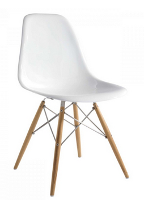
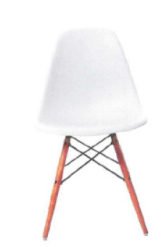
DSW - Vitra
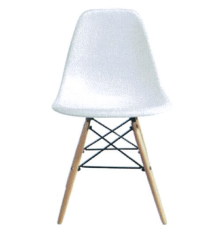
Paris - Kwantum
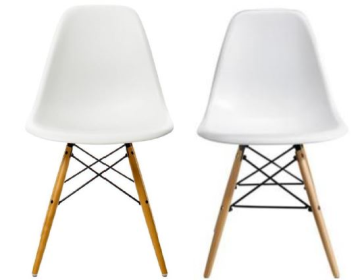
DSW Paris
The EU is not a party to the Berne Convention and there is no European regulation for the criterion of material reciprocity in Art. 2 (7) BC. It is assumed that EU member states may decide for themselves whether or not to disapply the criterion of material reciprocity under Art. 2 (7) BC with respect to a work whose country of origin is a third country or whose author is a third-country national. However, it could be concluded from the CJEU's RAAP (IPPT20200908, CJEU, RAAP v PPI) ruling that the criterion of material reciprocity of Art. 2(7) BC should also be excluded within the EU with respect to a work or author from a third country.
In those circumstances, the Hoge Raad der Nederlanden (Supreme Court of the Netherlands) decided to stay the proceedings and to refer the following questions to the Court of Justice for a preliminary ruling:
"(1) Does the situation at issue in these proceedings fall within the material scope of EU law?
Should the preceding question be answered in the affirmative, the following questions are also submitted.
(2) Does the fact that copyright [in] a work of applied art forms an integral part of the right to protection of intellectual property enshrined in Article 17(2) of the Charter mean that EU law, in particular Article 52(1) of the Charter, in order to limit the exercise of copyright (within the meaning of Directive [2001/29]) [in] a work of applied art by application of the [criterion of] material reciprocity [provided for in] Article 2(7) [of the Berne Convention], requires this limitation to be provided for by law?
(3) Must Articles 2, 3 and 4 of Directive [2001/29] and Articles 17(2) and 52(1) of the Charter, read in the light of Article 2(7) [of the Berne Convention], be interpreted as meaning that it is solely for the EU legislature (and not for national legislatures) to determine whether the exercise of copyright (within the meaning of Directive [2001/29]) in the European Union can be limited by application of the [criterion of] material reciprocity provided for in Article 2(7) [of the Berne Convention] in respect of a work of applied art whose country of origin within the meaning of [that convention] is a third country and whose author is not a national of an EU Member State and, if so, to define that limitation clearly and precisely … ?
(4) Must Articles 2, 3 and 4 of Directive [2001/29], read in conjunction with Articles 17(2) and 52(1) of the Charter, be interpreted as meaning that[,] as long as the EU legislature has not provided for a limitation [on] the exercise of copyright (within the meaning of Directive [2001/29]) [in] a work of applied art by application of the [criterion of] material reciprocity [provided for in] Article 2(7) [of the Berne Convention], EU Member States may not apply that [criterion] in respect of a work of applied art whose country of origin within the meaning of [that convention] is a third country and whose author is not a national of an EU Member State?
(5) In the circumstances at issue in the present proceedings and given the time of the establishment of (the predecessor of) Article 2(7) [of the Berne Convention], are the conditions of the first paragraph of Article 351 TFEU satisfied for [the Kingdom of] Belgium, meaning that [that Member State] is therefore free to apply the [criterion of] material reciprocity provided for in Article 2(7) [of that convention], taking into account the fact that[,] in the present case[,] the country of origin acceded to the Berne Convention on 1 May 1989?"