













Trade Mark law not te be used to permanently monopolise technical solutions
28-01-2026 Print this page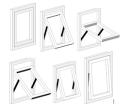
The EU General Court, like EUIPO, refuses the application for a motion mark showing the opening and closing of a window, because the sign merely represents a technical functional process. The essential characteristics of the sign are technically necessary to achieve a result, such as ventilation and stability. Article 7(1)(e)(ii) EUTMR prevents trade mark law from being used to permanently monopolise technical solutions, thereby extending the limited protection afforded by other intellectual property rights.
In case T-9/25, the General Court of the European Union examines an application by Kct GmbH & Co. KG for registration of a motion mark as a European Union trade mark. The mark consists of an animation showing the opening and closing of a hinged window. EUIPO refuses the application on the ground that the sign lacks distinctive character and merely represents a technical functional process. The Board of Appeal of EUIPO upholds that decision.
The General Court concurs. It finds that the essential characteristics of the motion mark consist of the successive images of a window opening and closing, including visible moving components such as struts. All of those characteristics perform a technical function, namely enabling ventilation and light admission and supporting and stabilising the window during movement.
According to the General Court, the sign therefore consists exclusively of characteristics that are necessary to obtain a technical result. The mark consequently falls under the absolute ground for refusal laid down in Article 7(1)(e)(ii) of Regulation (EU) 2017/1001 (EUTMR). That provision prevents trade mark law from granting an exclusive and permanent right over technical solutions or functional features.
The General Court emphasises that trade mark law must not be used to extend de facto the duration of protection of other intellectual property rights, such as patents. The assessment focuses on the objective technical function of the elements represented, not on how the relevant public may perceive the sign.
Arguments put forward by Kct, such as reliance on visual variations or the alleged non-technical nature of certain aspects of the animation, fail to persuade the General Court. Those elements do not alter the fact that the sign, taken as a whole, merely depicts a technical process.
The General Court concludes that a motion mark which solely shows the operation of a technical product cannot be registered as a trade mark.
IPPT-version will follow anytime soon
ECLI:EU:T:2026:9, case T-9/25